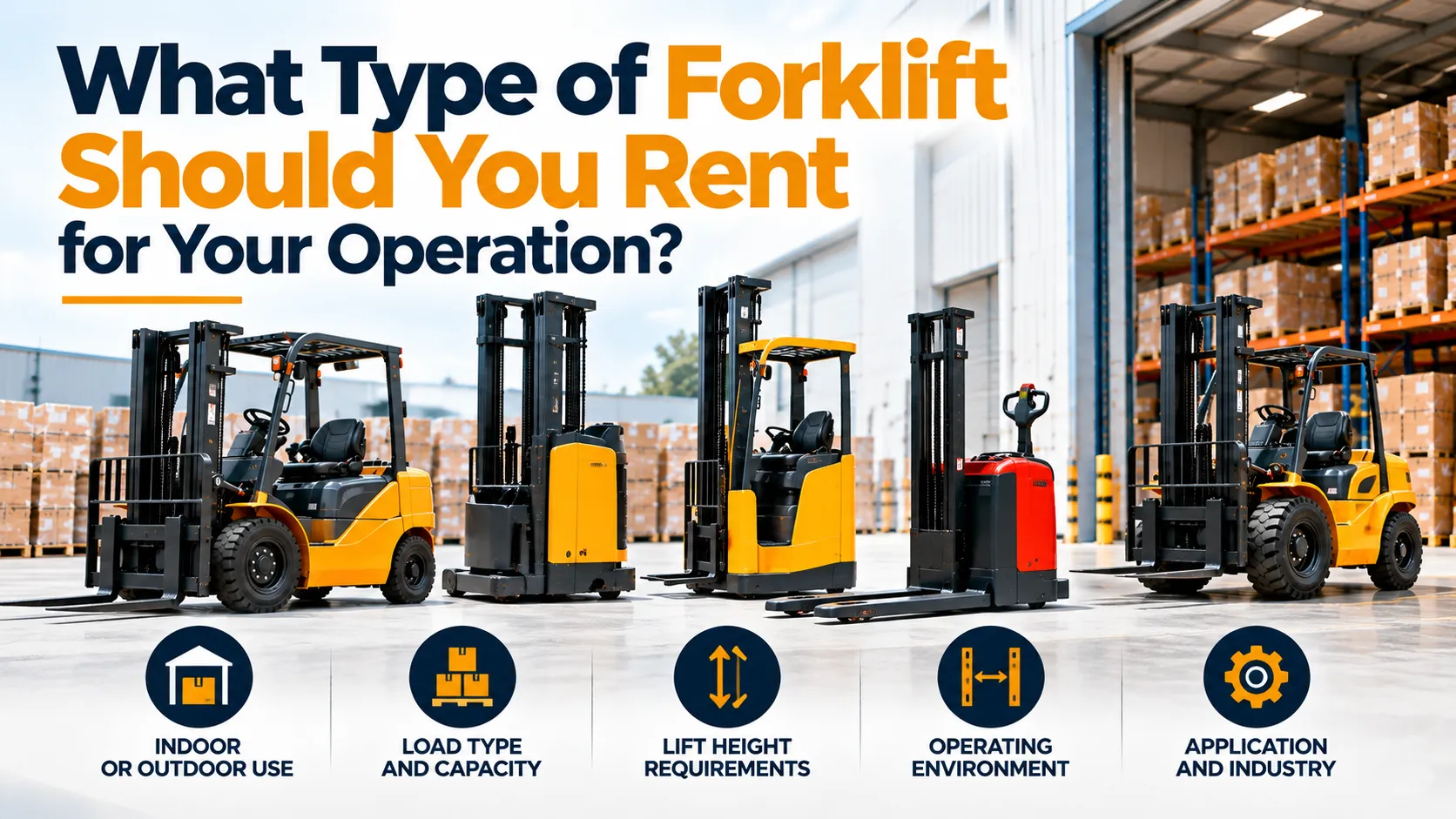
Choosing equipment for a warehouse or industrial task starts with the load and the worksite. A forklift suited to a smooth warehouse floor may not fit an outdoor yard, narrow aisle or job requiring a particular lift height.
This guide to types of forklifts for rent explains common equipment categories and the questions to ask a supplier. These are general industry examples; confirm which types VA Material actually offers for rental before making availability claims.
Start with the job, not the machine name
Record the heaviest load, dimensions, required lift height, travel distance, operating hours and worksite surface. Also note aisle width, ramps, ventilation, loading-dock conditions and attachment requirements.
Counterbalance forklifts
Counterbalance forklifts are commonly used for moving loads in warehouses, yards, manufacturing areas and loading operations, subject to the model and site conditions. Evaluate capacity, load center, lift height, turning space, tires, power source and surface suitability.
Electric forklifts
Electric forklifts are often considered for indoor operations where exhaust emissions and noise matter. Check battery capacity, charging time, shift length, floor condition and whether the configuration can handle the load at the required height.
Diesel or internal-combustion forklifts
These may suit some outdoor or demanding industrial applications when the equipment fits the environment. Confirm ground conditions, gradients, ventilation, fuel arrangements, load requirements and site restrictions.
Reach trucks, pallet trucks and stackers
Reach trucks can suit some rack-storage applications and narrower aisles. Pallet trucks or stackers may fit horizontal pallet movement or lower-lift tasks. They are not interchangeable with every forklift; select based on the actual job.
Capacity and lift height matter together
Rated capacity is not a guarantee that a machine can lift every load of the same weight in every configuration. Load center, lift height and attachments can affect usable capacity. Ask the supplier to confirm suitability against the manufacturer's capacity plate and instructions.
Questions to ask before requesting a quote
Ask which equipment is actually available, what capacity and lift-height range fits the job, whether the unit suits the site's aisle and surface conditions, and which delivery, maintenance and operator arrangements apply.
Frequently Asked Questions
Which forklift is best for a warehouse?
It depends on the load, lift height, aisle width, floor condition, travel route and operating hours.
Is an electric forklift always better indoors?
Not automatically. The equipment must fit the task, capacity, battery needs and site conditions.
Choose equipment against real requirements
A clear description of the load, lift height, site and schedule helps suppliers assess suitable equipment. VA Material can discuss equipment requirements and relevant product or service options; confirm rental availability and specific equipment directly.