Reach Truck vs. Forklift: What Is the Difference?
Choosing the right material-handling equipment can have a significant impact on warehouse productivity, storage capacity, and operating efficiency.
Two types of equipment that are often compared are reach trucks and forklifts.
Although both are designed to move and lift palletized loads, they are built for different operating conditions.
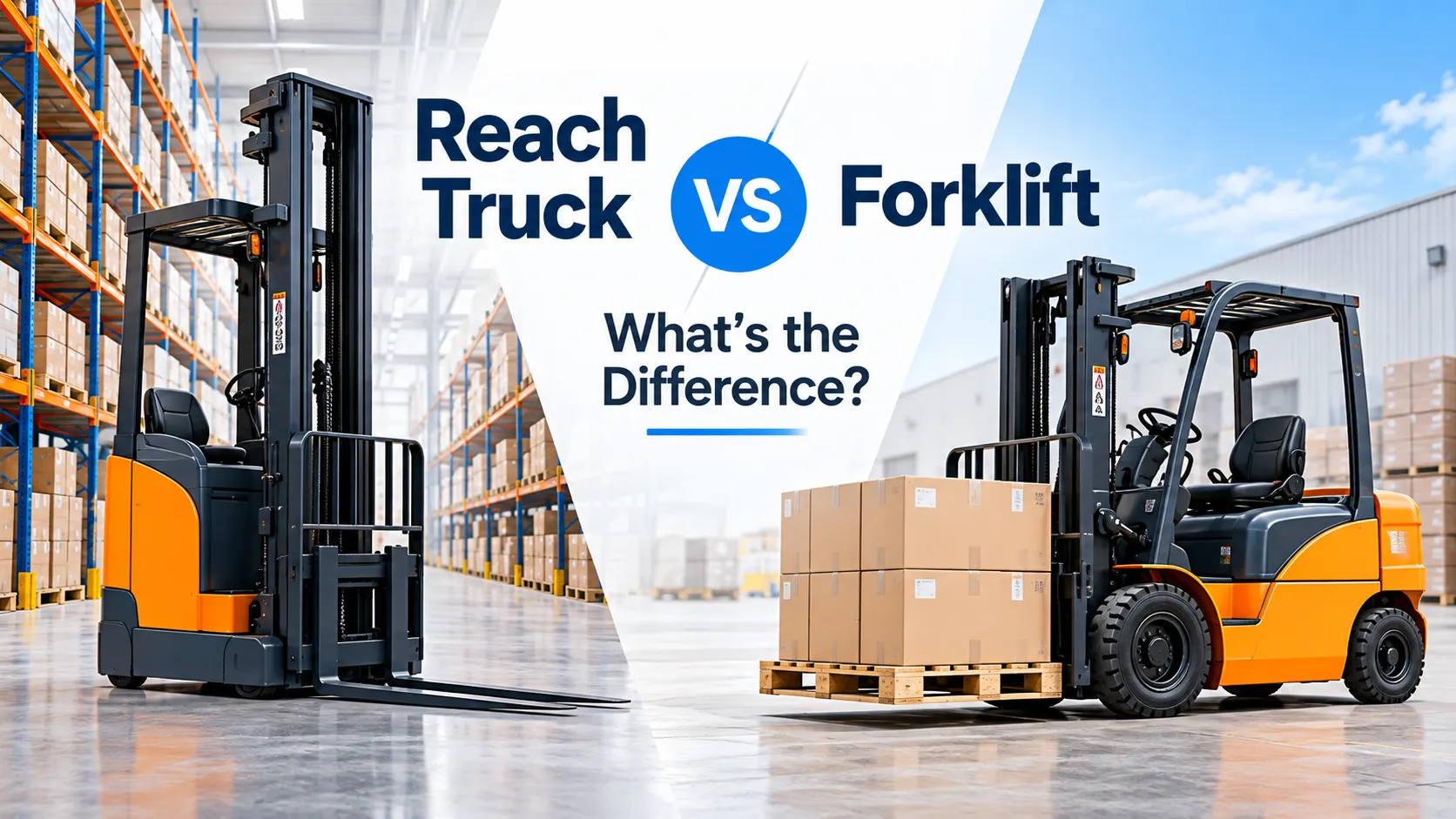
A traditional counterbalance forklift can be a versatile choice for general material handling, loading and unloading, and indoor or outdoor applications. A reach truck, on the other hand, is specifically designed for warehouse environments where high storage racks, narrow aisles, and maneuverability are important.
Understanding the differences can help businesses determine which equipment is better suited to their warehouse.
Reach Truck vs. Forklift at a Glance
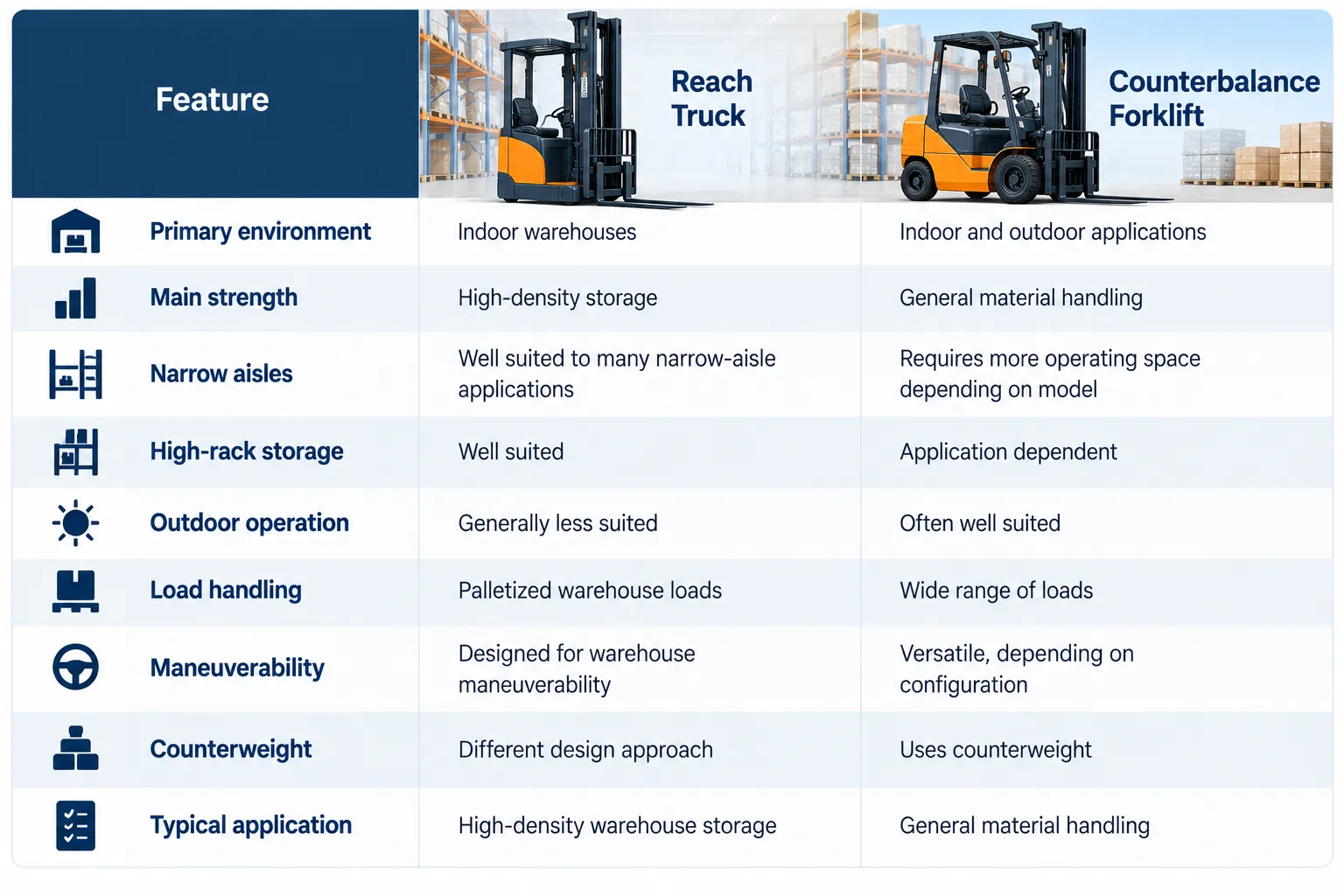
Actual capabilities vary by manufacturer and model, so equipment specifications should always be reviewed before selection.
What Is a Reach Truck?
A reach truck is a type of electric warehouse forklift designed primarily for applications involving pallet storage at height and relatively narrow warehouse aisles.
The equipment uses a mast and fork mechanism designed to reach into storage racks, allowing operators to retrieve and place pallets in elevated positions.
Reach trucks are commonly associated with:
- Distribution centers
- Warehouses
- High-density storage facilities
- Narrow-aisle applications
- High-rack storage
Their design focuses on maneuverability and efficient use of vertical warehouse space.
What Is a Counterbalance Forklift?
A counterbalance forklift is a general-purpose forklift design used across many material-handling applications.
The forklift uses a counterweight at the rear to balance the load carried by the forks.
Depending on the model, counterbalance forklifts can be used for:
- Loading and unloading trucks
- Moving pallets
- Manufacturing operations
- Warehouses
- Industrial facilities
- Outdoor yards
- General material handling
They are available in different power sources, capacities and configurations.
The Main Difference Between a Reach Truck and a Forklift
The most important difference is how each machine is designed to work within an operating environment.
A reach truck is primarily optimized for:
warehouse storage + narrow aisles + elevated pallet handling
A counterbalance forklift is primarily optimized for:
general material handling + loading/unloading + broader operating environments
Neither is universally better.
The right equipment depends on your warehouse layout and material-handling requirements.
1. Warehouse Aisle Width
A major consideration is aisle width.Lorem ipsum dolor sit amet, consectetur adipiscing elit. Ut elit tellus, luctus nec ullamcorper mattis, pulvinar dapibus leo.
Warehouses that use high-density storage systems may have relatively narrow aisles.
In these environments, maneuverability becomes extremely important.
Reach trucks are designed for warehouse applications where the equipment needs to work within constrained spaces.
A counterbalance forklift may require more space to maneuver depending on its design and configuration.
Before selecting equipment, measure:
- Aisle width
- Rack spacing
- Turning area
- Pallet dimensions
- Load dimensions
- Clearance around storage systems
Don’t rely on a general statement such as “this is a narrow-aisle forklift.”
The actual dimensions of the equipment and warehouse need to be evaluated together.
2. Lifting Height
Reach trucks are particularly associated with high-level pallet storage.
They can be designed to lift loads to significant heights, depending on the model.
This can make them useful for warehouses that want to maximize vertical storage.
However, maximum lifting height should not be considered by itself.
Businesses should also consider:However, maximum lifting height should not be considered by itself.
- Rated capacity at the required height
- Load center
- Rack configuration
- Building clearance
- Pallet dimensions
- Operator visibility
A forklift’s rated capacity can change depending on lift height and load configuration.
3. Warehouse Storage Density
Warehouse space is expensive.
Businesses often look for ways to store more products within the same facility.
High-density storage can involve:
- Taller racks
- Narrower aisles
- Greater vertical utilization
- More organized pallet locations
Reach trucks can support these types of warehouse strategies because they are designed around elevated pallet storage and maneuverability.
A counterbalance forklift may still be the right choice for facilities where storage density is not the primary concern.
4. Outdoor Operation
Counterbalance forklifts generally provide greater flexibility for many outdoor applications.
They can be used for activities such as:
- Truck loading
- Yard operations
- Outdoor material movement
- Industrial handling
- Construction-related material handling
Reach trucks are primarily designed for warehouse environments.
If your forklift regularly moves between indoor storage areas and outdoor yards, a counterbalance forklift may provide greater versatility depending on the specific model.
5. Load Types
Both reach trucks and forklifts can handle palletized loads, but the application matters.
A reach truck is particularly useful for warehouse pallets stored on racks.
A counterbalance forklift can handle a broader range of material-handling tasks depending on its capacity and attachments.
For example, some operations may need to:
- Move pallets
- Load trucks
- Unload containers
- Move machinery
- Handle industrial materials
- Transport materials around a yard
In these situations, a counterbalance forklift may offer greater versatility.Lorem ipsum dolor sit amet, consectetur adipiscing elit. Ut elit tellus, luctus nec ullamcorper mattis, pulvinar dapibus leo.
6. Maneuverability
Maneuverability is one of the key advantages of warehouse-focused equipment.
Reach trucks are designed to operate efficiently in warehouse environments where space is limited.
This can be particularly valuable when:
- Aisles are narrow
- Storage racks are close together
- Products are stored at height
- Traffic is concentrated in certain areas
However, maneuverability should always be evaluated using the actual equipment dimensions and warehouse layout.
7. Visibility and Operator Position
Reach truck and counterbalance forklift designs differ in operator position and visibility.
Depending on the model, a reach truck may provide visibility advantages for certain high-rack warehouse applications.
Operators need to be able to:
- See the load
- Position the forks accurately
- Monitor rack clearance
- Maneuver safely
- Place and retrieve pallets
The actual visibility characteristics depend on the equipment design, mast configuration and load.
8. Electric Reach Trucks vs. Other Forklift Types
Most reach trucks used in modern warehouse environments are electric.
This can provide advantages for indoor operations, including:
- Low operating noise
- No tailpipe emissions during operation
- Suitability for controlled indoor environments
- Compatibility with warehouse operations
However, electric forklifts also require an appropriate battery and charging strategy.
For businesses running multiple shifts, battery capacity and charging infrastructure should be considered when evaluating reach trucks.
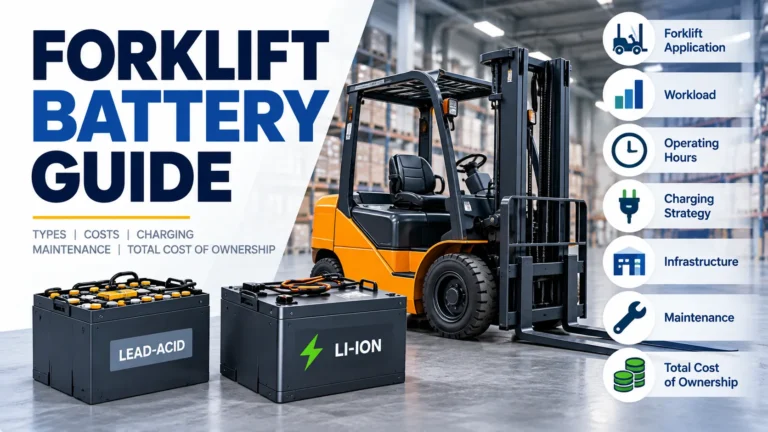
This connects directly to our previous article:
Forklift Battery Guide: Lead-Acid vs. Lithium-Ion Batteries
When Should You Choose a Reach Truck?
A reach truck may be worth considering if your operation has several of the following characteristics:
High Storage Racks
Your warehouse relies heavily on vertical storage.
Narrow Aisles
Available aisle space is limited.
Indoor Operation
The equipment will primarily operate inside a warehouse.
Palletized Goods
Your operation frequently stores and retrieves palletized products.
High Storage Density
Maximizing storage capacity is a priority.
Repetitive Rack Handling
The equipment will frequently place and retrieve pallets from storage racks.
If these conditions describe your operation, a reach truck may be a suitable equipment category to evaluate.
When Should You Choose a Counterbalance Forklift?
A counterbalance forklift may be more appropriate when your operation requires versatility.
Consider one when you need equipment for:
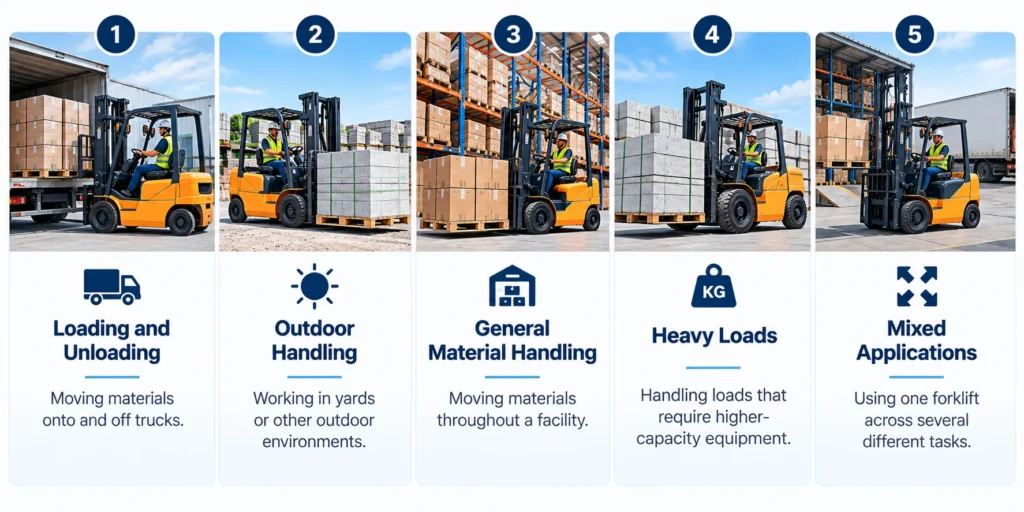
The appropriate model should still be selected according to load capacity, operating environment and manufacturer specifications.
Can a Reach Truck Replace a Forklift?
Not necessarily.
Reach trucks and counterbalance forklifts often serve different operational purposes.Not necessarily.
For example, a warehouse might use:
Reach truck
Move pallets into high storage racks
Counterbalance forklift
Unload incoming trucks
Electric pallet truck
Move pallets across the warehouse floor
Using different equipment for different stages of the workflow can sometimes be more efficient than expecting one machine to perform every task.
Can a Forklift Be Used in Narrow Aisles?
Some forklifts can operate in relatively narrow aisles, depending on their dimensions and configuration.
However, aisle requirements depend on factors such as:
- Forklift dimensions
- Turning radius
- Load dimensions
- Rack configuration
- Pallet orientation
- Required clearance
- Operator maneuvering requirements
For warehouses specifically designed around narrow-aisle storage, a reach truck or other specialized warehouse equipment may be more appropriate.
Reach Truck vs. Forklift: Cost Considerations
Purchase price should not be the only factor when comparing equipment.
Consider:
- Initial purchase cost
- Battery
- Charger
- Maintenance
- Energy consumption
- Operator requirements
- Productivity
- Storage capacity
- Equipment utilization
- Downtime
For example, a reach truck may cost more than a basic warehouse forklift, but if it allows the business to use vertical storage more effectively, its overall value could be different.
Similarly, purchasing a specialized reach truck for a facility that does not need high-rack storage may not provide a meaningful operational advantage.
Total Cost of Ownership
A useful way to compare equipment is to evaluate total cost of ownership (TCO).
Consider:
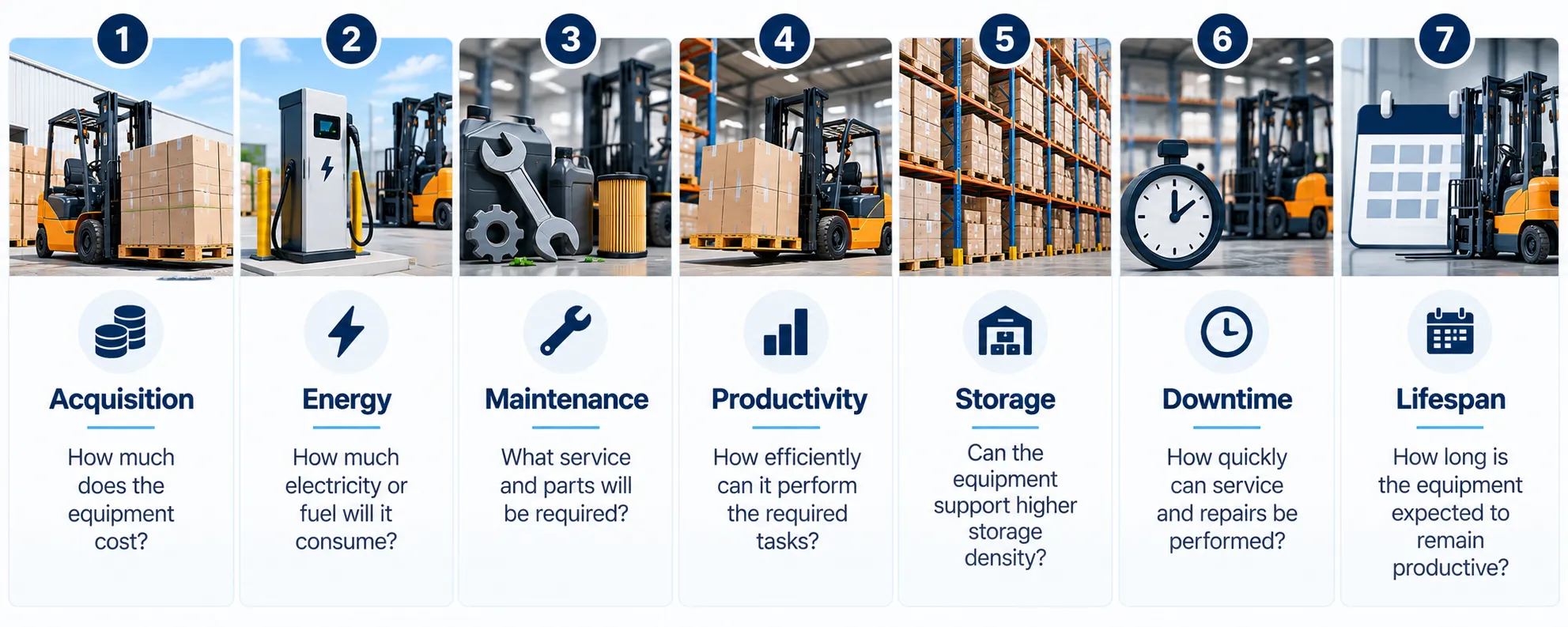
This provides a more realistic comparison than looking only at the purchase price.
Reach Truck vs. Forklift Selection Checklist
Before selecting equipment, answer these questions.
Warehouse
- What is the aisle width?
- What is the rack height?
- How high must pallets be stored?
- What are the rack dimensions?
Loads
- What is the average load weight?
- What is the maximum load weight?
- What are the pallet dimensions?
- What is the load center?
Operation
- Indoor or outdoor?
- How many hours per day?
- How many shifts?
- How frequently will pallets be moved?
Equipment
- Reach truck?
- Counterbalance forklift?
- Electric forklift?
- Pallet truck?
- Stacker?
Infrastructure
- Battery charging available?
- Appropriate electrical capacity?
- Maintenance support available?
- Replacement parts available?
Reach Truck vs. Forklift: Which Is Right for You?
The decision comes down to the operating environment.
A reach truck may be the better option when:
- Your warehouse has narrow aisles
- You rely on high storage racks
- Vertical storage is important
- Most operations occur indoors
- Pallet retrieval from racks is a major activity
A counterbalance forklift may be better when:
- You need general-purpose material handling
- Outdoor operation is required
- Truck loading and unloading are frequent
- You handle different types of materials
- Equipment versatility is important
Some operations may benefit from both.
A warehouse can use reach trucks for high-density storage while using counterbalance forklifts for loading, unloading and outdoor material handling.
Choosing Equipment Based on Your Warehouse
The best material-handling equipment isn’t necessarily the largest, newest or most powerful machine.
It is the equipment that fits the actual workflow.
Before choosing between a reach truck and a counterbalance forklift, evaluate:
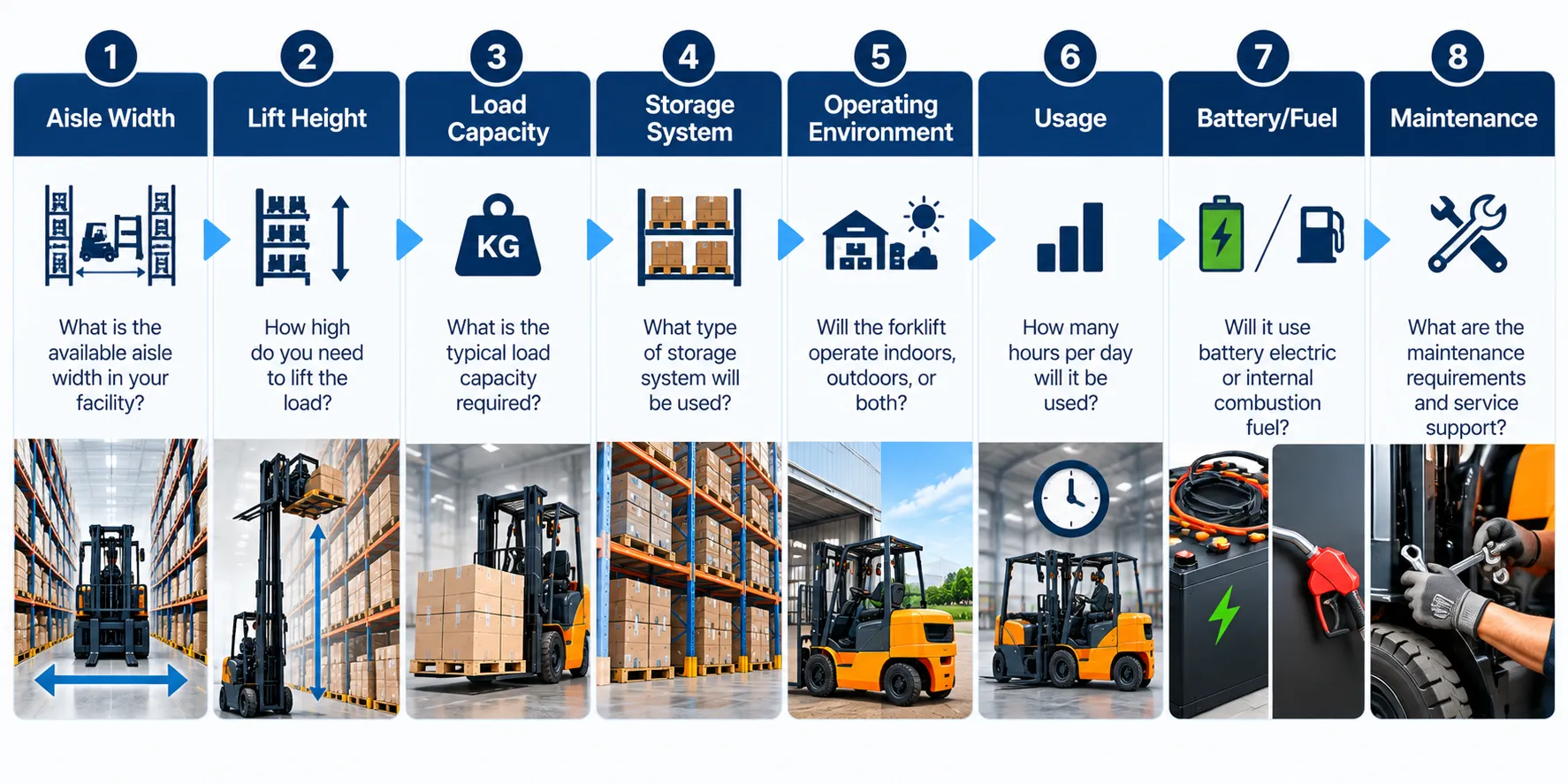
These factors provide a more reliable basis for equipment selection.
Need Help Selecting Warehouse Equipment?
VA Materials provides material-handling solutions for businesses in the Philippines.
If you’re evaluating a reach truck, forklift, pallet truck, stacker or other warehouse equipment, start by reviewing your facility layout, storage system, load requirements and operating schedule.
A proper equipment assessment can help identify the right type of machine for your operation.
Explore VA Materials’ material-handling equipment solutions to find equipment suited to your warehouse requirements.
Reach trucks and counterbalance forklifts are designed to solve different material-handling problems.
A reach truck is particularly suited to indoor warehouse operations, narrow aisles and high-rack storage, while a counterbalance forklift provides broader versatility for general material handling, loading, unloading and many outdoor applications.
Rather than asking which machine is universally better, businesses should ask:
Which equipment is best suited to the way our warehouse actually operates?
By evaluating aisle width, lifting height, load capacity, storage density, operating environment and total cost of ownership, businesses can make a more informed equipment decision.