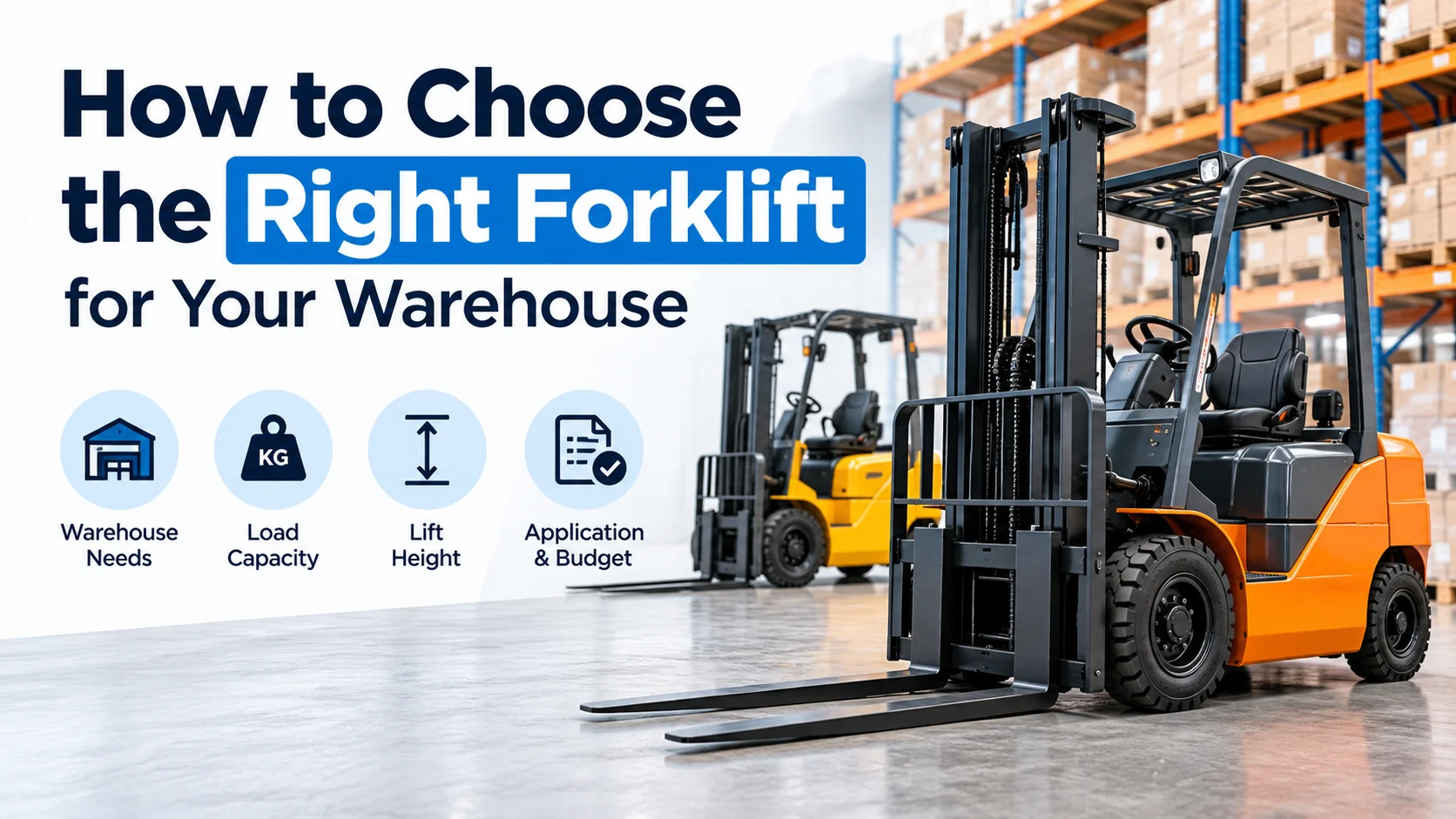
How to Choose the Right Forklift for Your Warehouse
Choosing the right forklift is an important decision for any warehouse, distribution center, manufacturing facility, or industrial operation. The right equipment can make material handling faster and more efficient, while the wrong forklift can create unnecessary operating costs, safety concerns, and workflow limitations.
With different forklift types, capacities, lift heights, power systems, and configurations available, the best choice depends on how and where the equipment will be used.
Before purchasing a forklift, businesses should evaluate their load requirements, warehouse layout, lifting height, operating environment, power source, operating hours, and maintenance needs.
This guide explains the key factors to consider when selecting a forklift for your operation.
1. Understand What You Need the Forklift to Do
The first step in forklift selection is to understand the actual material-handling tasks the equipment will perform.
Consider questions such as:
- What type of materials will the forklift move?
- How heavy are the typical loads?
- How high do loads need to be lifted?
- How frequently will the forklift operate?
- Will it operate indoors, outdoors, or both?
- How much space is available for maneuvering?
- Will the forklift work in narrow aisles?
- What type of surfaces will it operate on?
These questions help narrow down the type and specifications of forklift that will work best for your facility.
A forklift used primarily inside a warehouse may have very different requirements from equipment used in a manufacturing yard, construction environment, or outdoor loading area.
2. Determine the Required Load Capacity
One of the most important specifications to consider is load capacity.
Forklifts are designed to safely handle specific maximum loads. Choosing equipment with insufficient capacity can create serious operational and safety risks, while selecting a forklift with significantly more capacity than necessary may increase equipment and operating costs.
Start by identifying:
- Your typical load weight
- Your maximum load weight
- Load dimensions
- Load center
- How the load will be positioned on the forks
For example, if your operation routinely handles heavier pallets, machinery, or industrial materials, the forklift must have an appropriate rated capacity for those loads.
It’s also important to consider that forklift capacity can change depending on lift height, attachments, and load center.
For this reason, the manufacturer’s capacity rating should always be checked against the actual operating requirements.
3. Consider Your Required Lift Height
Warehouse operations often require loads to be placed on different levels of storage racks.
Before choosing a forklift, determine the maximum height at which the equipment will need to place or retrieve loads.
Ask:
How high does the forklift actually need to lift?
A warehouse with standard pallet storage may have different requirements from a high-density facility using tall storage racks.
For high-rack applications, equipment such as reach trucks may be more appropriate because they are designed for warehouse environments where vertical storage and maneuverability are important.
When evaluating lift height, don’t look only at the maximum advertised height. Consider the required capacity at that height as well.
4. Evaluate Your Warehouse Aisle Width
Warehouse space is another major factor in forklift selection.
A forklift needs enough room to:
- Enter an aisle
- Turn safely
- Position its forks
- Pick up a load
- Place the load into storage
- Exit the aisle
If your facility has narrow aisles, a large counterbalance forklift may not be the most efficient option.
Depending on the application, reach trucks, stackers, or other warehouse equipment may provide better maneuverability.
Before purchasing equipment, measure your actual aisle widths and compare them with the manufacturer’s recommended operating dimensions.
5. Choose the Right Power Source
Forklifts are available with different power systems, and the operating environment should play a major role in this decision.
Electric Forklifts
Electric forklifts are often well suited for indoor warehouse environments.
Potential advantages include:
- Low operating noise
- No tailpipe emissions during operation
- Suitable for indoor environments
- Efficient operation
- Reduced exposure to exhaust emissions
They can be particularly useful in warehouses where cleanliness, noise levels, and indoor air quality are important considerations.
Diesel or Internal Combustion Forklifts
Internal combustion forklifts can be suitable for applications that require heavier-duty performance, particularly in outdoor or demanding industrial environments.
Depending on the model and application, they may be used for:
- Outdoor material handling
- Heavy loads
- Loading and unloading
- Manufacturing environments
- Yard operations
The right choice depends on the operating conditions, load requirements, facility layout, and expected usage.
Related article: Electric vs. Diesel Forklifts: Which Is Right for Your Business?
6. Consider the Type of Forklift
Different forklift designs are suited to different applications.
Counterbalance Forklifts
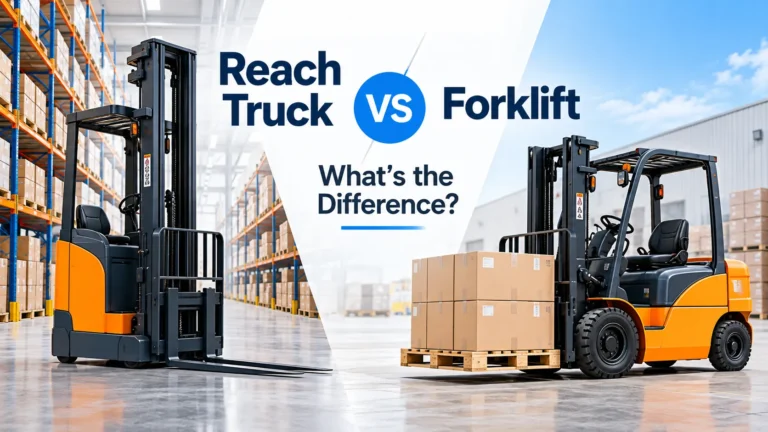
Counterbalance forklifts are widely used for general material handling.
They can be suitable for:
- Loading and unloading
- Moving pallets
- Manufacturing facilities
- Warehouses
- Outdoor material handling
Reach Trucks
Reach trucks are designed primarily for warehouse applications where vertical storage and maneuverability are important.
They can be useful for:
- High storage racks
- Narrower warehouse aisles
- Distribution centers
- High-density storage
Electric Pallet Trucks
Pallet trucks are designed for moving palletized loads over relatively short distances.
They can be useful for:
- Warehouse movement
- Loading and unloading
- Order fulfillment
- Distribution operations
Electric Stackers
Stackers combine pallet movement with stacking capability and can be useful for operations that require lifting pallets to storage positions without necessarily requiring a larger counterbalance forklift.
Tow Tractors and Order Pickers
Specialized warehouse applications may require equipment designed for specific tasks, such as towing loads or picking products from storage locations.
The best equipment depends on the workflow rather than simply choosing the largest or most powerful forklift available.
7. Consider Your Operating Environment
Where the forklift operates can significantly affect your equipment choice.
Indoor Warehouses
Consider:
- Electric forklifts
- Reach trucks
- Electric pallet trucks
- Stackers
These options may be appropriate where maneuverability, noise and emissions are important considerations.
Outdoor Operations
Outdoor environments may require equipment capable of handling:
- Uneven surfaces
- Weather exposure
- Heavier loads
- Longer operating cycles
Internal combustion forklifts may be appropriate for some of these applications.
Mixed Indoor and Outdoor Operations
If equipment regularly moves between indoor and outdoor areas, consider the conditions on both sides of the operation.
A forklift that performs well in an outdoor yard may not necessarily be the best option for narrow indoor warehouse aisles.
8. Think About Your Daily Operating Hours
How frequently your forklift operates should also influence your decision.
A business operating a forklift for a few hours a day may have different requirements from a facility running equipment continuously across multiple shifts.
Consider:
- Hours of operation
- Number of shifts
- Charging requirements
- Refueling requirements
- Battery capacity
- Operator availability
- Maintenance intervals
For electric forklifts, battery capacity and charging strategy become particularly important when equipment is used for extended periods.
Businesses with intensive operations may need to evaluate charging infrastructure, battery management, and whether additional batteries or equipment are required to maintain productivity.
9. Don't Forget Maintenance and Service
Purchasing a forklift is only one part of equipment ownership.
A forklift requires regular inspection, maintenance, and servicing to remain reliable and safe to operate.
Before selecting a supplier, consider:
- Availability of replacement parts
- Preventive maintenance
- Technical support
- Repair services
- Battery support
- Service response time
- Availability of trained technicians
A lower initial purchase price does not necessarily mean lower overall operating costs.
Reliable after-sales support can help reduce unexpected downtime and keep equipment operating efficiently.
Related article: Forklift Maintenance: A Practical Guide to Keeping Your Equipment Safe and Reliable
10. Consider the Total Cost of Ownership
The purchase price should not be the only financial consideration.
A forklift’s total cost can include:
- Purchase price
- Energy or fuel
- Battery costs
- Maintenance
- Replacement parts
- Tires
- Repairs
- Operator requirements
- Downtime
- Equipment lifespan
For this reason, businesses should consider total cost of ownership (TCO) when comparing forklift options.
A forklift with a higher initial purchase price may potentially provide better long-term value if it has lower operating costs, better efficiency, or stronger reliability for the intended application.
11. Think About Safety and Operator Requirements
Forklift selection should always consider workplace safety.
Depending on your application, evaluate:
- Operator visibility
- Load stability
- Mast configuration
- Turning radius
- Braking system
- Safety features
- Operator ergonomics
- Facility traffic patterns
Operators should also receive appropriate training for the equipment they operate.
The forklift should be selected based on the actual workplace conditions rather than solely on specifications listed in a product brochure.
12. Choose a Supplier That Can Support Your Operation
Selecting the right forklift is not only about selecting the right machine.
The supplier can also play an important role in the long-term success of the equipment.
Look for a supplier that can provide:
- Product guidance
- Equipment options
- Replacement parts
- Preventive maintenance
- Repair support
- Technical assistance
- Battery solutions
For businesses operating material-handling equipment in the Philippines, having access to local support can be particularly important when equipment downtime directly affects warehouse operations.
Forklift Selection Checklist
Final Thoughts
Choosing the right forklift starts with understanding your operation rather than simply selecting the most powerful or lowest-priced machine.
The right equipment should match your load requirements, lifting height, warehouse layout, operating environment, usage patterns, and long-term maintenance needs.
For some businesses, an electric forklift may be the right solution. Others may benefit from an internal combustion forklift, reach truck, stacker, pallet truck, or another specialized material-handling solution.
The key is to match the equipment to the actual job.
VA Materials provides forklift and material-handling solutions for businesses in the Philippines. If you’re evaluating equipment for your warehouse or industrial operation, reviewing your load requirements and operating environment is a good first step toward identifying the right solution.
Before making a purchase decision, review these questions:
Application
- What materials will be handled?
- What is the maximum load weight?
- What are the load dimensions?
Application
- What is the aisle width?
- What is the required lifting height?
- What type of flooring is used?
Warehouse
- How many hours will the forklift operate each day?
- How many shifts will it support?
- Will it operate indoors, outdoors, or both?
Operation
- Electric or internal combustion?
- Counterbalance, reach truck, stacker, or pallet truck?
- What capacity is required?
- What attachments are needed?
Equipment
- What are the maintenance requirements?
- Are replacement parts readily available?
- What service support is available?
- What is the expected total cost of ownership?