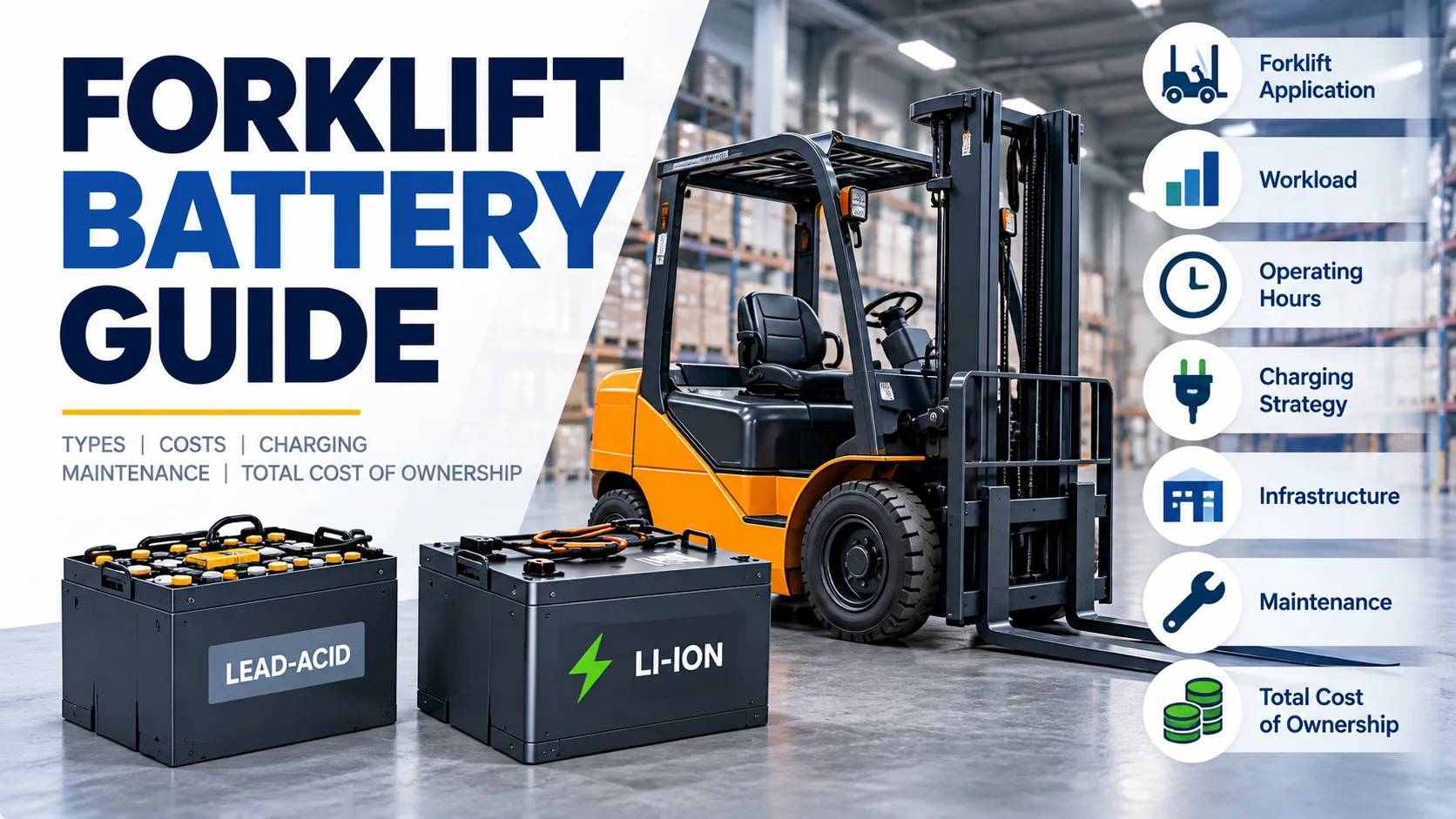
Forklift Battery Guide: Lead-Acid vs. Lithium-Ion Batteries
The battery is one of the most important components of an electric forklift.
It provides the energy needed to move the equipment, lift loads, and complete daily warehouse operations. For businesses operating electric forklifts, the choice of battery can affect equipment availability, charging requirements, maintenance, operating costs, and overall productivity.
Two of the most common battery technologies used in electric forklift applications are lead-acid and lithium-ion batteries.
Both technologies have advantages and limitations. The right choice depends on factors such as operating hours, charging infrastructure, equipment requirements, budget, maintenance practices, and the working environment.
This guide explains the differences between lead-acid and lithium-ion forklift batteries and the factors businesses should consider before choosing one.
What Is a Forklift Battery?
A forklift battery is an energy storage system used to power an electric forklift.
Unlike internal combustion forklifts that use fuel-powered engines, electric forklifts rely on batteries to power their drive and lifting systems.
The battery affects several aspects of forklift operation, including:
- Operating time
- Charging requirements
- Equipment availability
- Maintenance
- Energy consumption
- Battery replacement costs
- Overall operating strategy
For businesses running electric forklifts for multiple shifts, battery management becomes particularly important.
Lead-Acid vs. Lithium-Ion Forklift Batteries
At a high level, the two technologies differ in their construction, charging characteristics, maintenance requirements, and operating considerations.
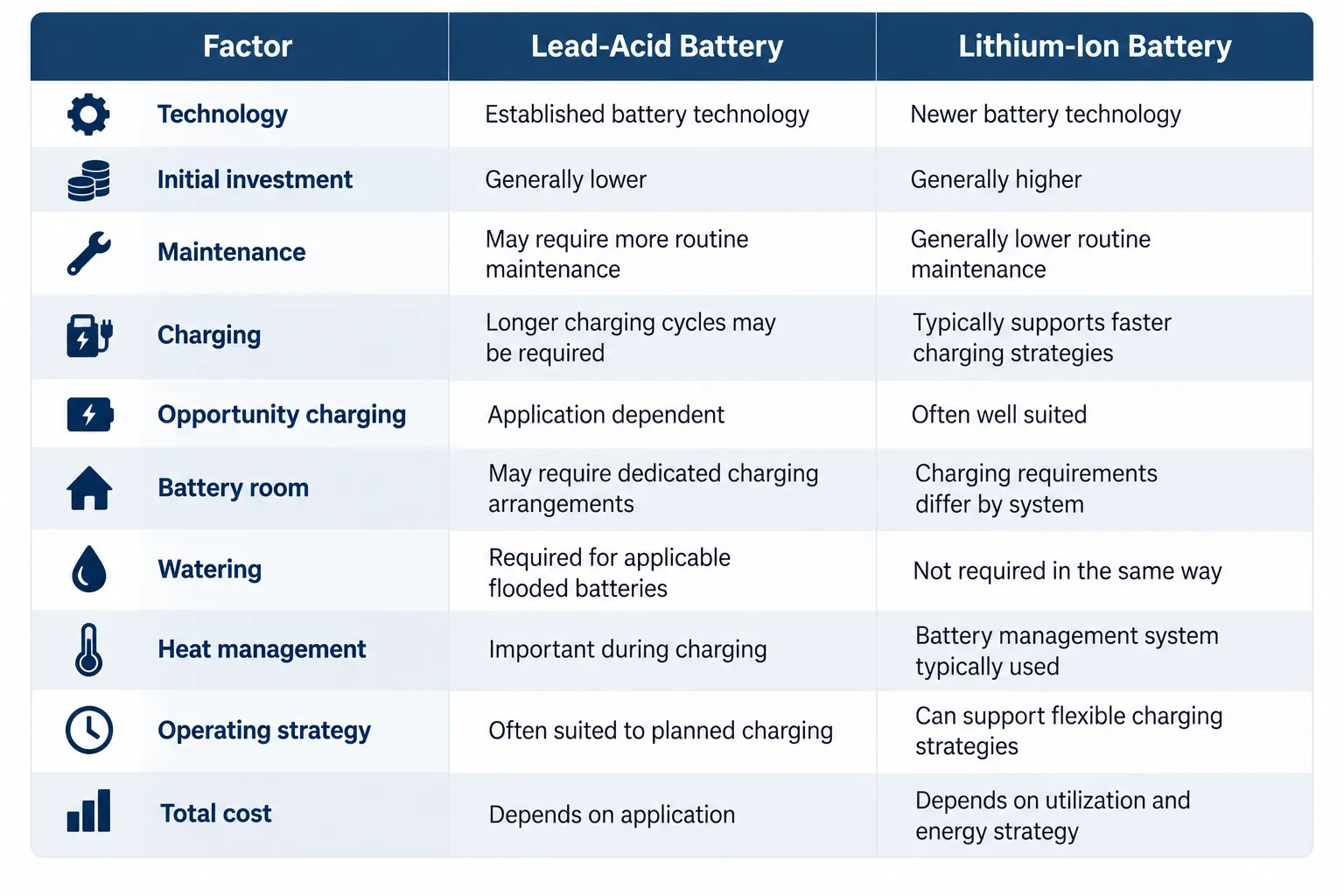
These are general characteristics. Actual performance depends on the battery design, forklift model, charging system, operating environment, and manufacturer’s specifications.
What Is a Lead-Acid Forklift Battery?
Lead-acid batteries have been used in electric forklifts for many years and remain a common option for material-handling applications.
They use lead plates and an electrolyte to store and release electrical energy.
Different types of lead-acid batteries are available, including flooded and other designs with different maintenance requirements.
What Is a Lead-Acid Forklift Battery?
1. Established Technology
Lead-acid batteries have a long history of use in material-handling equipment.
This means businesses can find established charging, maintenance and replacement practices.
2. Lower Initial Investment
Lead-acid batteries can have a lower initial purchase cost than some lithium-ion systems.
For businesses primarily focused on initial equipment investment, this can make them an attractive option.
However, purchase price should not be the only factor considered.
3. Familiar Maintenance Practices
Businesses and service technicians are generally familiar with lead-acid battery maintenance.
For applicable flooded batteries, maintenance may include:
- Watering
- Cleaning
- Checking connections
- Inspecting battery condition
- Following proper charging procedures
Maintenance requirements depend on the specific battery type.
Considerations When Using Lead-Acid Batteries
Lead-acid batteries also have characteristics that businesses need to consider.
Charging Time
Charging may require longer periods compared with some lithium-ion systems.
This means businesses operating multiple shifts may need to carefully plan battery charging and equipment availability.
Maintenance
Applicable flooded lead-acid batteries require regular maintenance, including proper electrolyte management.
Charging Area
Businesses should establish an appropriate battery charging area and follow manufacturer and workplace safety requirements.
Battery Handling
Forklift batteries can be heavy. Battery handling and replacement therefore require appropriate equipment and procedures.
What Is a Lithium-Ion Forklift Battery?
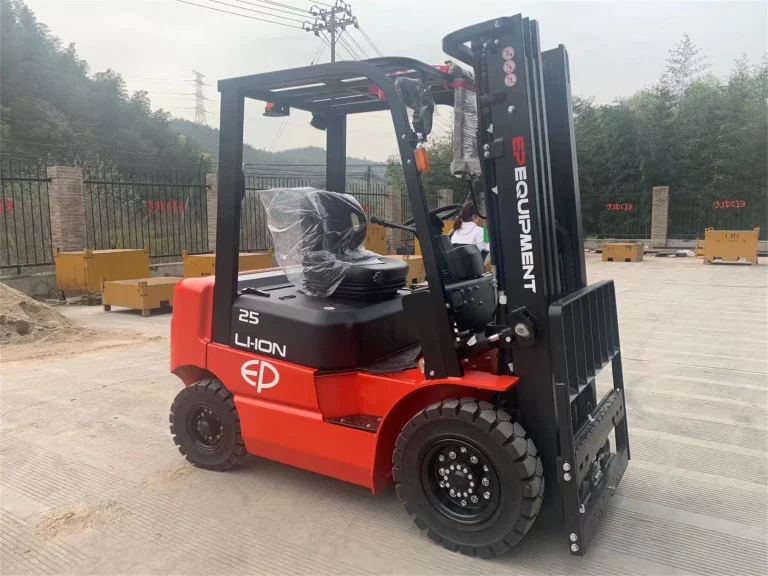
Lithium-ion batteries use lithium-based battery chemistry to store electrical energy.
They have become increasingly relevant to electric material-handling applications because of their charging characteristics, energy efficiency and reduced routine maintenance requirements compared with certain lead-acid battery systems.
Lithium-ion systems typically incorporate a battery management system (BMS) that monitors battery conditions and helps manage charging and operation.
Advantages of Lithium-Ion Forklift Batteries
1. Opportunity Charging
One of the major advantages of lithium-ion batteries is their suitability for certain opportunity-charging strategies.
Instead of relying solely on long charging periods, businesses may be able to charge equipment during scheduled breaks or other short periods, depending on the battery and forklift manufacturer’s specifications.
This can be useful for operations with demanding utilization schedules.
2. Reduced Routine Maintenance
Lithium-ion batteries generally do not require the same type of electrolyte watering associated with flooded lead-acid batteries.
This can reduce certain routine maintenance tasks.
However, lithium-ion batteries still require proper inspection, charging practices, monitoring and maintenance according to manufacturer requirements.
3. Consistent Power Delivery
Lithium-ion systems can provide relatively consistent power output during operation.
This can help electric forklifts maintain predictable performance throughout a work cycle, depending on the battery system and application.
4. Flexible Charging Strategies
For operations where forklifts operate for long periods or across multiple shifts, flexible charging can be an important consideration.
Businesses may be able to incorporate charging into operational breaks rather than relying entirely on extended charging periods.
The actual charging strategy should always follow the battery manufacturer’s requirements.
Considerations When Choosing Lithium-Ion Batteries
Lithium-ion batteries also have factors that businesses need to evaluate.
Higher Initial Investment
The initial purchase price can be higher than a comparable lead-acid battery system.
However, businesses should evaluate the complete operating model rather than comparing acquisition cost alone.
Charging Infrastructure
The charging equipment and electrical infrastructure must be appropriate for the battery system.
Compatibility
The battery must be compatible with the forklift, charger and operating requirements.
Application Requirements
Not every forklift application will benefit equally from lithium-ion technology.
The operating schedule, equipment utilization and charging strategy should be evaluated before making a decision.
Lead-Acid vs. Lithium-Ion: Which Has the Longer Life?
Battery lifespan depends on several factors.
These can include:
- Charging practices
- Depth of discharge
- Operating temperature
- Maintenance
- Number of charging cycles
- Equipment utilization
- Battery quality
- Storage conditions
It is therefore difficult to state that one technology will always last longer in every application.
Proper battery management is often just as important as the technology itself.
Which Forklift Battery Is Better for Multiple-Shift Operations?
Multiple-shift operations should pay particular attention to battery availability and charging strategy.Lorem ipsum dolor sit amet, consectetur adipiscing elit. Ut elit tellus, luctus nec ullamcorper mattis, pulvinar dapibus leo.
A business operating one shift may have enough time to charge a battery between work periods.
A facility operating two or three shifts may need a different approach.
Consider:
- Operating hours per shift
- Break schedules
- Charging time
- Number of forklifts
- Number of batteries
- Charging locations
- Electrical capacity
- Opportunity-charging capability
Lithium-ion batteries can be attractive for some high-utilization operations because of their charging characteristics.
However, the right solution depends on the specific equipment and application.
Which Battery Is Better for a Warehouse?
There is no universal answer.
Lead-acid may be suitable when:
- Initial investment is a major consideration
- Operations can accommodate longer charging periods
- Battery maintenance can be managed properly
- Equipment utilization is predictable
- Existing charging infrastructure supports the battery system
Lithium-ion may be suitable when:
- Equipment utilization is high
- Opportunity charging is useful
- Reduced routine battery maintenance is desirable
- Flexible charging is important
- The operation can support the required charging infrastructure
The best choice should be based on the entire operating environment rather than battery technology alone.
Forklift Battery Charging Best Practices
Proper charging is essential for battery performance and safety. Businesses should always follow the manufacturer’s charging instructions.
General considerations include:
Use the Correct Charger
The charger should be compatible with the battery system.
Follow Charging Instructions
Do not use charging procedures that are inconsistent with the battery manufacturer’s requirements.
Maintain the Charging Area
The charging area should be appropriately designed and maintained according to applicable workplace requirements.
Monitor Battery Condition
Watch for signs of:
- Damage
- Excessive heat
- Unusual odors
- Swelling
- Leakage
- Damaged cables or connectors
Any abnormal condition should be evaluated appropriately before continuing operation.
Lead-Acid Battery Maintenance
For applicable flooded lead-acid batteries, routine maintenance can include:
Electrolyte Level
Check electrolyte levels according to the manufacturer’s instructions.
Battery Cleanliness
Keep the battery clean and free from excessive dirt or contaminants.
Connections
Inspect terminals and connections for corrosion or damage.
Charging
Use the correct charging procedure and avoid improper charging practices.
Physical Condition
Check for visible damage or abnormalities.
Maintenance requirements vary by battery design, so the manufacturer’s instructions should always take priority.
Lithium-Ion Battery Maintenance
Lithium-ion batteries generally require different maintenance practices.
Businesses should:
- Follow the manufacturer's charging requirements
- Monitor battery condition
- Keep connectors and charging equipment clean
- Inspect cables
- Follow recommended operating temperatures
- Monitor battery-management-system warnings
- Address abnormal battery behavior promptly
Lithium-ion does not mean maintenance-free.
Proper charging, inspection and equipment management remain important.
How Much Does a Forklift Battery Cost?
Forklift battery pricing varies significantly depending on:
- Battery technology
- Voltage
- Capacity
- Forklift model
- Battery size
- Manufacturer
- Charger requirements
- Installation
- Application
Because of these variables, businesses should avoid comparing batteries based solely on purchase price.
A better approach is to evaluate:
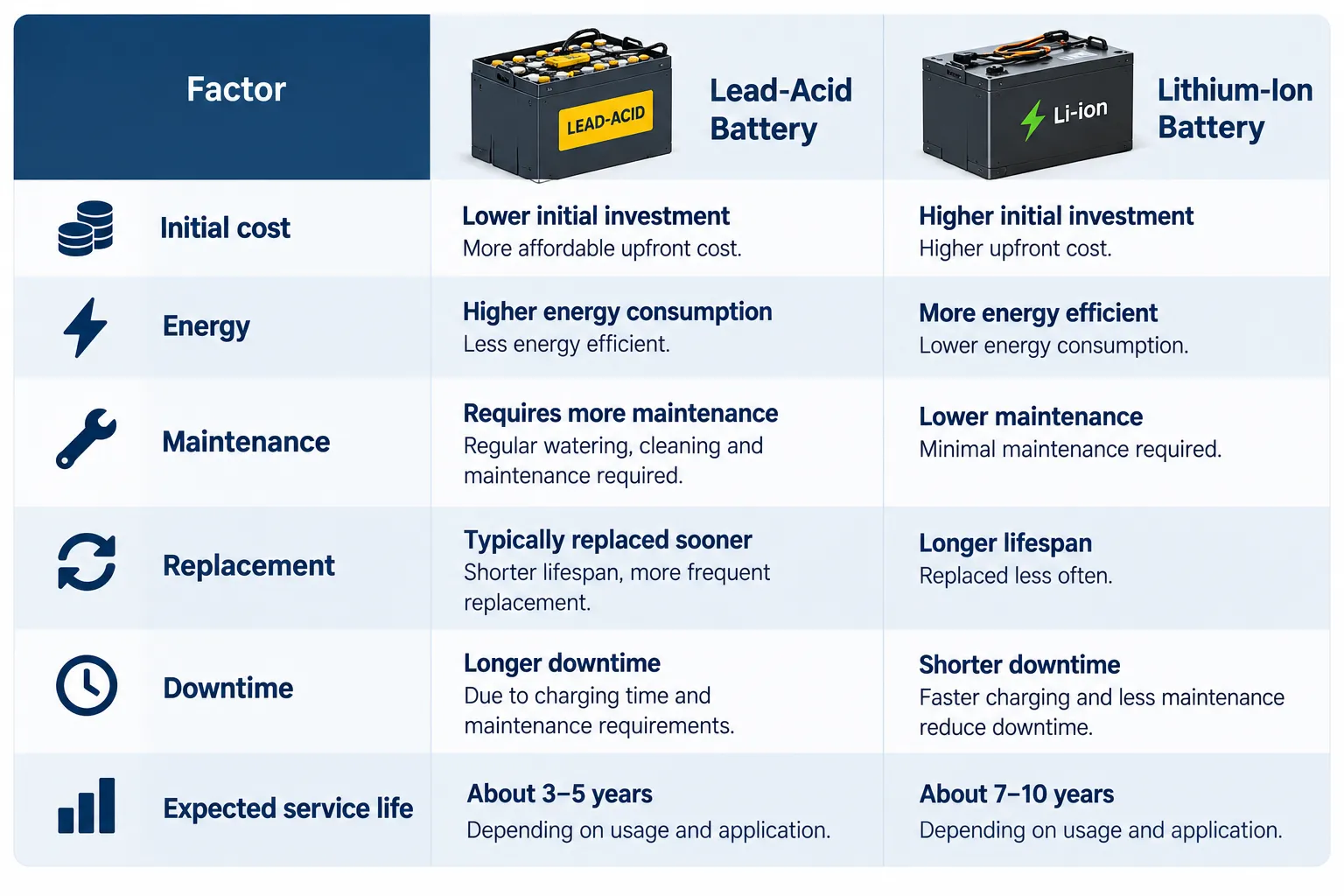
This provides a more useful picture of total battery ownership cost.
Total Cost of Ownership
The total cost of a forklift battery can extend well beyond the initial purchase.
The total cost of a forklift battery can extend well beyond the initial purchase.
Initial Investment
How much does the battery and associated charging equipment cost?
Energy
How much electricity is required during normal operation?
Maintenance
What routine maintenance is required?
Replacement
How frequently will the battery need to be replaced?
Downtime
Could charging or battery problems reduce equipment availability?
Infrastructure
Are additional electrical or charging facilities required?
A battery with a higher initial cost may potentially make sense if it provides operational advantages that reduce other costs.
Conversely, a lower-cost battery may be appropriate when the operating environment and charging schedule fit its characteristics.
Signs That a Forklift Battery May Need Attention
Operators and maintenance teams should monitor battery performance.
Operators and maintenance teams should monitor battery performance.
- Reduced operating time
- Longer charging periods
- Unusual heat
- Physical damage
- Battery swelling
- Battery swelling
- Leakage
- Charging problems
- Unexpected battery-management warnings
- Reduced forklift performance
These signs should not be ignored.
The battery and charging system should be evaluated according to the manufacturer’s procedures.
Should You Replace or Maintain a Forklift Battery?
The answer depends on battery condition and operating requirements.
Consider:
Battery Age
Older batteries may have reduced capacity.
Performance
If the battery no longer provides sufficient operating time, replacement may need to be considered.
Maintenance History
Poor maintenance can contribute to premature battery problems.
Operating Requirements
If the business has increased its operating hours or moved to multiple shifts, the existing battery strategy may no longer be adequate.
Cost
Compare the cost of continued maintenance with the cost and potential operational benefits of replacement.
How to Choose the Right Forklift Battery
Before purchasing a battery, gather the following information:
1. Forklift Model
Confirm the exact equipment model.
2. Voltage
The battery must meet the forklift’s electrical requirements.
3. Capacity
Determine the required battery capacity based on operating conditions.
4. Operating Hours
Determine the required battery capacity based on operating conditions.
5. Number of Shifts
Single-shift and multi-shift operations can have very different battery requirements.
6. Charging Strategy
Determine whether traditional charging or opportunity charging is appropriate.
7. Charging Infrastructure
Confirm that the facility can support the required charging equipment.
8. Maintenance Requirements
Consider the time and resources required to maintain the battery.
9. Total Cost of Ownership
Evaluate the complete lifecycle cost rather than only the purchase price.
Forklift Battery Selection Checklist
Use this checklist when evaluating a new battery:
Equipment
- Forklift model identified
- Required voltage confirmed
- Required capacity confirmed
- Battery dimensions confirmed
- Connector compatibility confirmed
Equipment
- Daily operating hours identified
- Number of shifts identified
- Typical workload identified
- Charging schedule established
Infrastructure
- Charger compatibility confirmed
- Charging area available
- Electrical requirements evaluated
- Battery handling process established
Maintenance
- Maintenance requirements understood
- Inspection process established
- Battery condition monitored
- Service support available
Cost
- Initial purchase cost evaluated
- Energy cost evaluated
- Maintenance cost evaluated
- Replacement cost evaluated
- Downtime risk considered
Which Is Better: Lead-Acid or Lithium-Ion?
The answer depends on the operation.
Choose Lead-Acid When:
Your operation can accommodate planned charging periods and routine battery maintenance, and the initial investment is an important consideration.
Consider Lithium-Ion When:
Your operation has high equipment utilization, benefits from flexible charging, and wants to reduce certain routine battery maintenance requirements.
Neither technology should be selected based on marketing claims alone.
The right battery should be matched to the forklift, workload, operating schedule, charging infrastructure and long-term equipment strategy.
The Battery Is Part of the Forklift System
A forklift battery should not be evaluated independently.
The battery works together with:
- Forklift
- Charger
- Electrical infrastructure
- Operator
- Maintenance program
- Operating schedule
Changing one part of the system can affect the others.
For example, moving from a traditional lead-acid battery strategy to lithium-ion may require changes to charging equipment and operating procedures.
This is why professional evaluation can be useful when selecting or upgrading a forklift battery system.
Need Help Choosing a Forklift Battery?
VA Materials provides material-handling solutions for businesses in the Philippines, including forklift and battery-related solutions.
If you’re evaluating a forklift battery, start by identifying your equipment model, operating hours, number of shifts, charging requirements and expected workload.
These factors can help determine whether a lead-acid or lithium-ion solution is appropriate for your operation.
Explore VA Materials’ forklift battery and material-handling solutions to find an option suited to your equipment and operating requirements.
Choosing between a lead-acid and lithium-ion forklift battery is ultimately an operational decision.
Lead-acid technology may make sense for businesses that have predictable charging schedules and are comfortable with routine battery maintenance. Lithium-ion technology may provide advantages for high-utilization operations where flexible charging and reduced routine maintenance are valuable.
The best choice depends on:
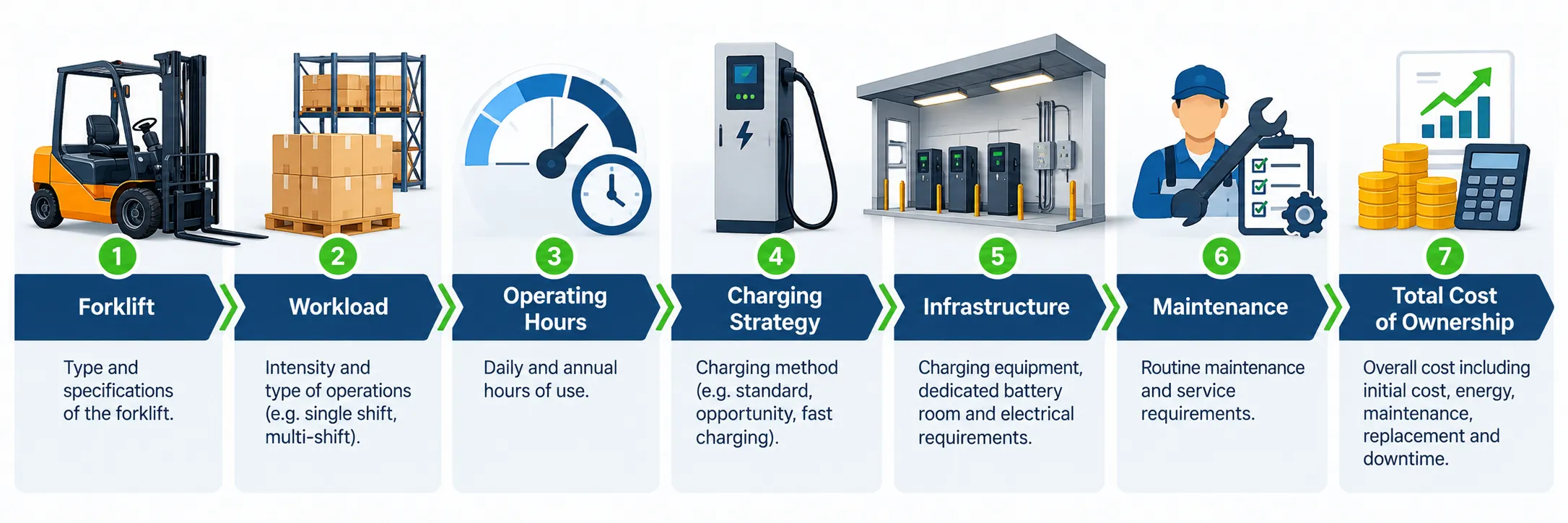
By evaluating these factors together, businesses can make a more informed decision about their forklift battery requirements.