Forklift Maintenance: A Practical Guide to Keeping Your Equipment Safe and Reliable
Forklifts play an important role in warehouses, manufacturing facilities, distribution centers, construction operations, and other industrial environments. When material-handling equipment is unavailable, even a relatively small mechanical problem can interrupt the movement of goods and affect daily operations.
Regular forklift maintenance helps businesses identify potential problems early, maintain equipment performance, and reduce unexpected downtime.
A good maintenance program should go beyond repairing a forklift after something breaks. It should include routine inspections, preventive maintenance, proper servicing, replacement of worn components, and attention to the operating environment.
This guide explains the key areas businesses should consider when maintaining forklifts and material-handling equipment.
Why Is Forklift Maintenance Important?
Forklifts operate under demanding conditions.
Depending on the application, equipment may repeatedly:
- Lift heavy loads
- Travel across warehouse floors
- Operate for several hours per day
- Move through narrow aisles
- Load and unload trucks
- Work in dusty or industrial environments
- Perform repeated lifting and lowering cycles
Over time, these operating conditions can contribute to component wear.
Regular maintenance helps businesses:
Reduce Unexpected Downtime
Identifying worn components before they fail can help reduce unexpected equipment interruptions.
Support Safe Operation
Regular inspections can identify problems involving brakes, steering, tires, forks, mast components and other critical systems.
Maintain Equipment Performance
Well-maintained equipment can operate more consistently and efficiently.
Protect Equipment Investment
Preventive maintenance can help extend the useful life of material-handling equipment.
Improve Maintenance Planning
Scheduled service allows businesses to plan maintenance instead of reacting to unexpected failures.
Forklift Maintenance vs. Forklift Repair
Although these terms are sometimes used interchangeably, they represent different activities.
Forklift Maintenance
Maintenance involves preventive and routine activities intended to keep equipment operating properly.
Examples include:
- Inspections
- Lubrication
- Fluid checks
- Battery checks
- Tire inspections
- Brake inspections
- Hydraulic system checks
- Scheduled servicing
Forklift Repair
Repair is generally required when a component has failed, become damaged, or requires corrective work.
Examples include:
- Hydraulic leaks
- Brake problems
- Steering issues
- Damaged forks
- Battery problems
- Engine problems
- Electrical faults
- Mast problems
A strong maintenance program aims to identify potential problems before they become major repairs.
Forklift Maintenance Checklist
The exact maintenance schedule should always follow the manufacturer’s recommendations and the specific operating conditions of the equipment.
However, businesses can use the following checklist as a starting point.
Daily Forklift Inspection
Before operating a forklift, operators should check the equipment for visible problems and ensure critical systems are functioning properly.
Areas to inspect may include:
Tires and Wheels
Check for:
- Visible damage
- Excessive wear
- Cuts
- Cracks
- Foreign objects
- Abnormal tire condition
Tire problems can affect stability, braking and maneuverability.
Forks
Inspect the forks for:
- Cracks
- Bending
- Excessive wear
- Damage
- Proper positioning
Forks are critical load-bearing components and should receive careful attention during inspections.
Mast and Lifting Components
Check for visible damage and abnormal operation.
- Unusual movement
- Hydraulic leaks
- Damaged chains
- Abnormal sounds
- Visible wear
If a problem is identified, the equipment should be evaluated before continued operation.Forks are critical load-bearing components and should receive careful attention during inspections.
Hydraulic System
Inspect hydraulic components for signs of:
- Fluid leaks
- Damaged hoses
- Loose connections
- Abnormal lifting behavior
Hydraulic problems can affect the forklift’s ability to safely lift and position loads.
Brakes
Test the braking system before normal operation.
Any unusual braking behavior should be addressed promptly.
Steering
Check that steering responds properly and that there are no unusual noises or resistance.
Safety Equipment
Depending on the forklift, inspect:
- Horn
- Lights
- Warning alarms
- Seat belt
- Mirrors
- Operator controls
- Safety devices
These systems contribute to safe equipment operation.
Forklift Maintenance Checklist
The frequency of maintenance should be based on the manufacturer’s recommendations and operating conditions.
Depending on the equipment, weekly checks may include:
- Battery condition
- Battery connections
- Fluid levels
- Hydraulic components
- Tire condition
- Mast components
- Chains
- Lubrication points
- Safety equipment
- General equipment condition
High-use equipment may require more frequent inspection.
Scheduled Preventive Maintenance
Daily inspections are only one part of a forklift maintenance program.
Forklifts should also receive scheduled preventive maintenance based on:
- Manufacturer recommendations
- Operating hours
- Equipment age
- Operating environment
- Usage intensity
- Equipment condition
A preventive maintenance program may include more detailed inspection and servicing of:
- Engine systems
- Transmission
- Hydraulic systems
- Brakes
- Steering
- Electrical systems
- Battery
- Mast assembly
- Chains
- Tires
- Lubrication points
The exact service requirements vary by forklift type and model.
Electric Forklift Maintenance
Electric forklifts have different maintenance requirements from internal combustion forklifts.
One of the most important areas is the battery.
Depending on the battery technology, maintenance may involve:
- Battery condition
- Charging practices
- Connections
- Charging equipment
- Battery temperature
- Electrolyte checks for applicable battery types
- Battery cleanliness
- Signs of damage
Proper battery management can affect equipment availability and battery lifespan.
Businesses should follow the battery manufacturer’s charging and maintenance requirements.
Diesel Forklift Maintenance
Diesel forklifts use internal combustion engines and therefore require engine-related maintenance.
Depending on the equipment, maintenance can include:
- Engine oil checks
- Oil changes
- Filter replacement
- Cooling system inspection
- Fuel system inspection
- Belts and hoses
- Engine components
- Exhaust system
- Hydraulic system
- Brakes
- Steering
The manufacturer’s recommended service intervals should be followed.
Common Forklift Problems
Regular maintenance can help identify common problems before they become more serious.
1. Hydraulic Leaks
Hydraulic leaks can reduce lifting performance and may indicate damaged hoses, seals, fittings or other components.
If a leak is identified, the equipment should be inspected by an appropriately qualified technician.
2. Battery Problems
Electric forklift performance can be affected by:
- Poor charging practices
- Battery age
- Damaged connections
- Incorrect charging
- Insufficient capacity
- Battery degradation
A battery that no longer provides sufficient operating time may require professional evaluation.
3. Brake Problems
Potential warning signs include:
- Reduced braking performance
- Unusual noises
- Increased stopping distance
- Brake pedal abnormalities
Brake problems should be addressed promptly.
4. Steering Problems
Difficulty steering or unusual steering behavior can indicate problems that require inspection.
Forklifts need predictable steering response, particularly when operating in narrow warehouse aisles.
5. Damaged or Worn Forks
Difficulty steering or unusual steering behavior can indicate problems that require inspection.
Forklifts need predictable steering response, particularly when operating in narrow warehouse aisles.
- Bending
- Cracks
- Excessive wear
- Uneven wear
- Other visible damage
Damaged forks should not simply be returned to service without proper evaluation.
When Should a Forklift Be Repaired?
A forklift should be evaluated when operators notice unusual behavior or visible damage.
Warning signs can include:
- Unusual noises
- Hydraulic leaks
- Reduced lifting performance
- Steering problems
- Brake problems
- Excessive vibration
- Battery performance problems
- Engine problems
- Warning lights
- Damaged forks
- Abnormal mast movement
The earlier a potential problem is identified, the easier it may be to plan corrective action.
Why Operator Inspections Matter
Maintenance isn’t solely the responsibility of the service team.
Forklift operators interact with the equipment every day and can often identify changes in performance early.
Operators should be encouraged to report:
- Unusual sounds
- Changes in steering
- Changes in braking
- Hydraulic leaks
- Battery issues
- Damaged components
- Warning indicators
- Other abnormal behavior
A simple reporting process can help maintenance teams respond before minor problems become larger issues.
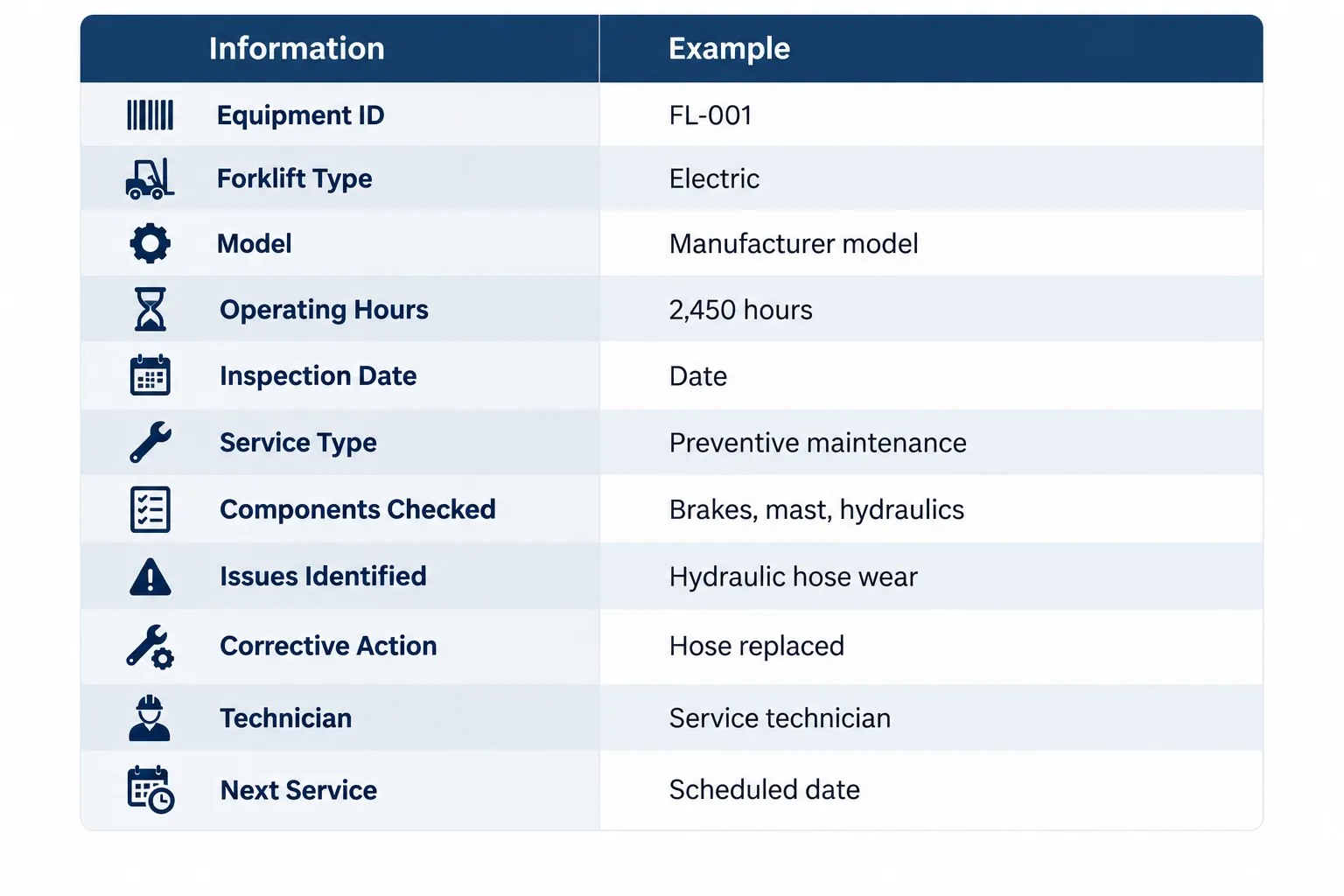
Forklift Maintenance Records
Businesses should maintain records of inspections and service activities.
A useful maintenance record may include:
How Often Should a Forklift Be Serviced?
There isn’t one maintenance interval that applies to every forklift.
Service frequency can depend on:
- Manufacturer recommendations
- Equipment model
- Operating hours
- Number of shifts
- Load intensity
- Operating environment
- Equipment age
- Maintenance history
A forklift used continuously in a demanding industrial environment may require more frequent attention than equipment used for a few hours each week.
The best starting point is the manufacturer’s maintenance schedule, followed by adjustments based on actual operating conditions.
Forklift Maintenance and Total Cost of Ownership
Maintenance is an important part of the forklift’s total cost of ownership (TCO).
The cost of owning equipment may include:
- Purchase price
- Energy or fuel
- Preventive maintenance
- Repairs
- Replacement parts
- Tires
- Batteries
- Labor
- Downtime
A preventive maintenance program can help businesses better understand these costs and identify recurring problems.
For example, repeated hydraulic repairs may indicate an underlying equipment or operating issue that needs further investigation.
Forklift Maintenance and Total Cost of Ownership
At some point, businesses may need to determine whether continued repair is financially practical.
Consider:
Equipment Age
Older equipment may require increasingly frequent repairs.
Repair Frequency
Repeated failures can increase maintenance costs and downtime.
Parts Availability
Parts availability can affect repair timelines.
Equipment Performance
Declining productivity may indicate that the equipment is no longer meeting operational requirements.
Operating Costs
Increasing fuel, energy, maintenance or repair costs may affect the overall economics of keeping the equipment.
Safety and Condition
If major components are significantly damaged or the equipment no longer meets operational requirements, replacement may need to be considered.
A professional equipment assessment can help businesses make a more informed decision.
How to Build a Forklift Maintenance Program
A practical maintenance program can be organized into several layers.
Step 1: Establish Daily Inspections
Operators perform basic checks before using equipment.
Step 2: Record Problems
Create a simple reporting system for defects and unusual equipment behavior.
Step 3: Schedule Preventive Maintenance
Use manufacturer recommendations and operating hours to schedule service.
Step 4: Track Repairs
Maintain records of components replaced and repairs completed.
Step 5: Monitor Equipment Performance
Track recurring issues and operating costs.
Step 6: Review Equipment Lifecycle
Periodically evaluate whether repair or replacement makes the most sense.
This approach turns maintenance from a reactive activity into a structured equipment-management process.
Forklift Maintenance Checklist
Before considering a forklift ready for operation, businesses can use this basic checklist as a reference:
Daily
- Check tires and wheels
- Inspect forks
- Check mast and lifting components
- Check hydraulic systems
- Test brakes
- Test steering
- Check horn and warning devices
- Check lights and safety equipment
- Check for visible leaks
- Report unusual equipment behavior
Scheduled
- Check battery or fuel system
- Inspect hydraulic components
- Inspect mast chains
- Inspect brakes
- Inspect steering system
- Inspect electrical systems
- Lubricate applicable components
- Replace required filters and fluids
- Review safety systems
- Record service activities
Track recurring issues and operating costs.
Important: This is a general reference, not a substitute for the manufacturer’s maintenance instructions or qualified technical service.
Professional Forklift Maintenance Support
A structured maintenance program can help businesses reduce unexpected downtime and keep material-handling equipment operating reliably.
For companies operating forklifts in the Philippines, access to appropriate forklift repair, maintenance, parts, and technical support can be an important consideration when selecting an equipment supplier.
VA Materials provides material-handling solutions and support for businesses in the Philippines.
If your forklift requires inspection, maintenance, repair, parts, or technical assistance, the appropriate service should be determined based on the equipment model and operating condition.
Explore VA Materials’ forklift services and support solutions for your material-handling equipment.
Forklift maintenance should be treated as an ongoing part of equipment management rather than something that only happens after a breakdown.
Regular inspections, preventive maintenance, proper battery or engine care, timely repairs, and accurate service records can help businesses maintain equipment reliability and identify potential problems earlier.
The most effective maintenance program is one that reflects the manufacturer’s recommendations, operating environment, equipment usage, and actual condition of the forklift.
For businesses that depend on material-handling equipment every day, investing in a structured maintenance process can help protect both equipment performance and warehouse productivity.